Oregon chain law for trucks: who must carry chains, where they go on each rig, and the $880 fine
Every vehicle over 10,000 pounds GVW must carry chains whenever they may be needed. Here is what ODOT requires once the signs say chain up.
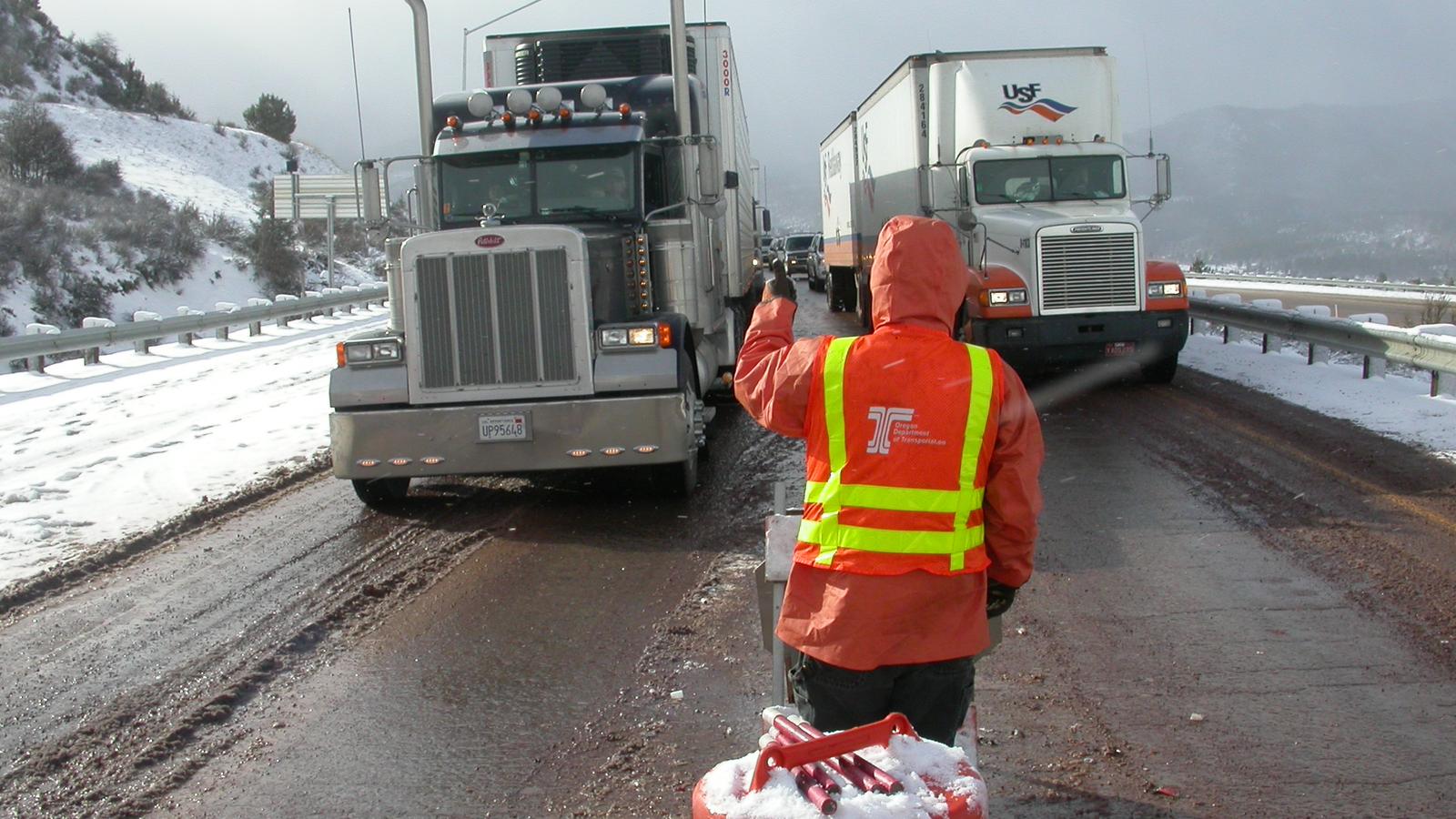
Oregon's chain rules apply to every heavy truck that crosses its mountain passes this winter, including carriers based in other states and provinces. ODOT's commercial vehicle quick facts flyer puts the basic rule plainly: all vehicles over 10,000 pounds gross vehicle weight must carry chains whenever their use may be needed or required.
When chains go on
- You must chain up whenever posted signs say chains are required.
- In typical winter conditions, vehicles rated at 10,000 pounds GVW or less that are not towing may use traction tires in place of chains.
- In very bad conditions, ODOT can require chains on all vehicles, regardless of vehicle type or tires. This is called a conditional road closure. ODOT says these are frequent in winter on Interstate 5 through the Siskiyou Pass south of Ashland.
ODOT defines chains as link chains, cable chains or any other device that attaches to the wheel, vehicle or outside of the tire and is specifically designed to increase traction on ice and snow.
Where the chains go
ODOT's minimum chain requirements set placement by configuration:
- Medium duty (over 10,000 and under 26,001 pounds GVW): single drive axle, one tire on each side of the drive axle. Tandem drive, two tires on each side of the primary drive axle.
- Solo commercial vehicle (26,001 pounds or more, not towing): single drive axle, one tire on each side of the drive axle. Tandem drive, two tires on each side of the primary drive axle. If both axles are powered by the driveline, one tire on each side of each drive axle.
- Tandem tractor with a semitrailer: two tires on each side of the primary drive axle (or one tire on each side of each drive axle if both are powered), plus two tires, one on each side, on any axle of the semitrailer.
- Tandem tractor with a semitrailer and a trailer: the same as above, plus one tire on the front axle and one tire on one of the rear axles of the trailer.
- B-train or C-train: two tires on each side of the primary drive axle (or each powered drive axle), two tires on any axle of the semitrailer at the B-train or C-train connection, and two tires on any axle of the rear semitrailer.
On a dual-wheel axle, when one tire must be chained, the chain may go on either the inside or the outside tire. The detailed rules are in Oregon Administrative Rule Chapter 734, Division 17, and ODOT tells drivers to contact a local ODOT Port of Entry with questions on commercial chain-up.
What it costs to skip it
The Oregon Legislature raised the fine for trucks that fail to use chains to $880 in 2021, according to ODOT's winter tips for commercial drivers. ODOT estimates that delays caused by trucks not following the chain law cost more than $8 million a year. Its flyer adds that a driver can also be fined for not having an appropriate set of chains for the rig.
Before the trip
- Check TripCheck.com for chain information, snow zone notices, closures and pass cameras.
- In Oregon, call 511 or 1-800-977-ODOT (6368). From outside Oregon, call 503-588-2941.
- Pick up a chain information card at a port of entry or an ODOT Commerce and Compliance office.
- Practice installing chains before the trip, and chain up in a safe, level spot such as a designated chain-up area.