Colorado chain season for trucks: the seven must-carry corridors, what counts as a chain, and the fines
From Sept. 1 to May 31, every commercial vehicle of 16,001 pounds or more must carry chains or an approved traction device on seven mountain routes, and the State Patrol runs proactive checks on I-70.
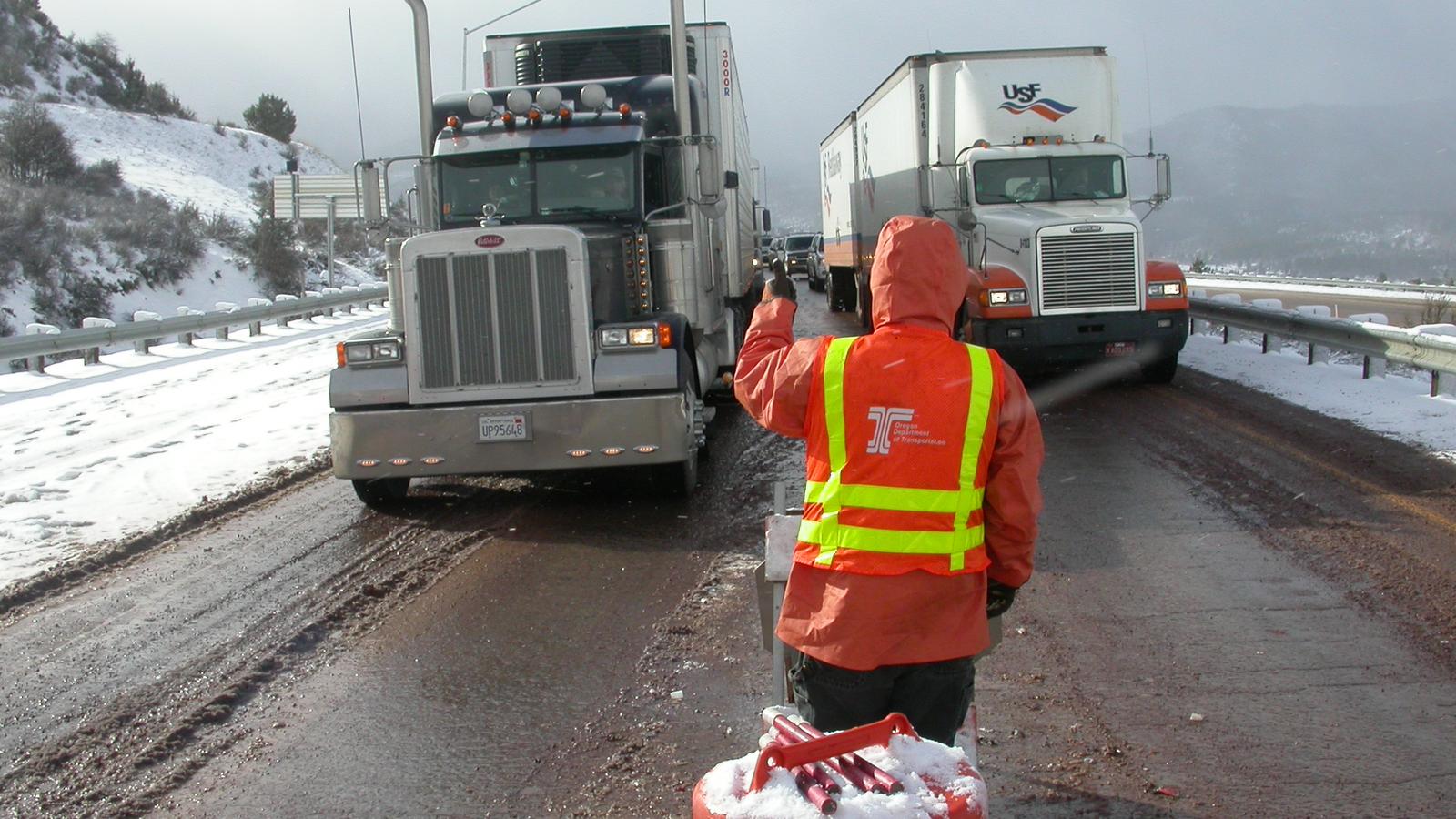
If your route crosses the Colorado Rockies this winter, the chains have to be on the truck before the snow starts, not just when the signs light up.
Here is what the Colorado Department of Transportation's freight office and the Colorado State Patrol say commercial drivers need to know.
Who has to carry chains
The rules apply to commercial motor vehicles with a gross vehicle or gross combination weight rating of at least 16,001 pounds used in commerce, and to vehicles of that weight carrying 16 or more passengers, including the driver. CDOT notes that this includes RVs at or above 16,001 pounds.
The seven must-carry corridors
From Sept. 1 through May 31, those vehicles must carry chains or approved alternative traction devices on these routes, whatever the weather:
- I-70 west of milepost 259 (Morrison)
- CO-9 from milepost 63 to 97 (Frisco to Fairplay)
- US 40 west of milepost 256 (Empire)
- US 50 west of milepost 225 (Salida)
- US 160 west of milepost 304 (Walsenburg)
- US 285 west of milepost 250 (Morrison)
- US 550 from milepost 0 to 130
The original must-carry rule covered part of I-70. It was expanded to the other corridors on Sept. 1, 2024, under Senate Bill 24-100.
When the chain law is active
When CDOT puts the commercial vehicle chain law into effect, a truck must have chains or approved devices on at least four drive tires, or all drive tires if it has fewer than four.
- Four drive tires: straight trucks, single and tandem drive axle combinations, auto transporters, and RVs with four drive tires at or above 16,001 pounds.
- Two drive tires: buses, and hot shots pulled by a pickup or similar vehicle that meets the 16,001-pound threshold.
Trailers do not need chains. Placarded hazmat vehicles must comply too, but may pass the chain-up signs and install chains where the pavement is covered with snow or ice, at a safe spot off the traveled lanes.
While the law is active, commercial vehicles must stay in the right lane. They may use the left or center lane only to pass a stalled or slower vehicle that would make them lose traction, and must return to the right lane immediately after.
The law stays in effect until CDOT announces it is lifted or the centerline or lanes are visible on a descending grade.
What counts
- Chains: two circular hoops, one on each side of the tire, joined by at least nine evenly spaced chains across the tread, meeting the SAE classification. Clip-on chains are not allowed.
- Cables: steel cable devices with high-strength cross-member rollers of 0.415 inch or more. If chains are on the two outside tires of one drive axle, cables may cover two tires on the other drive axle. AutoSocks and cables cannot be used together.
- Alternative traction devices: only products on CDOT's approved list. Drive wheel sanders and pneumatically driven chains are also allowed.
Fines
CDOT's freight office lists a fine of $100 or more plus a $32 surcharge for not carrying chains on the must-carry corridors. Statewide, failing to comply with winter driving restrictions can bring a fine of up to $500 plus surcharge, and getting stuck and blocking a travel lane can cost $1,000 plus surcharge. CDOT lists those surcharges as $78 and $156; the State Patrol's October notice lists them as $79 and $157.
Expect checks on I-70
The State Patrol checks chains at ports of entry, active chain-up stations and in daily roadside contacts. It also runs proactive chain carry checks on the I-70 mountain corridor, including in Eagle County near Dotsero, where the first event of this season was held Oct. 23. The Patrol says it schedules these checks on mild-weather days and posts a reminder on its official social media accounts the morning of each event.
CDOT's list of chain stations and its chain-up guide are on the CDOT freight website.